
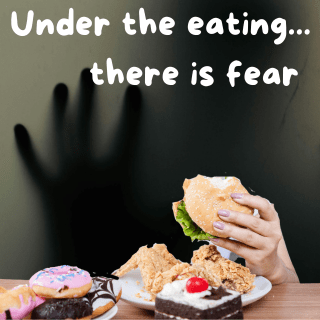
Last night I found myself eating in a way I hadn’t for a while. I made popcorn for the kids and told myself I was in a carb cycle so also ate a (big!) bowl myself, and then I found myself finishing off the leftover rice (which was more than a person should eat at any one time). Then, I had trouble falling asleep while my poor body attempted to deal with my bad decisions.
This morning I woke up and realized last nights weird binge (which hasn’t happened for ages) must be showing me something I didn’t want to face. I started journaling and realized: it’s fear. In fact, there are all kinds of conflicting fears inside me: fear of change, fear of not changing, fear of uncertainty. It’s making my head spin.
I closed my eyes and turned within. Right now, my fear is paralyzing me, but do I really want to stay just as I am? I know it’s safe and good, but what about all the longing and hard work I’ve done towards the things I said I wanted? Do I want to say safe, or do I want the big love and meaningful purpose knowing I helped change people’s lives for the better?
Underneath our issues with food (and life) is almost always fear.
You may not even be aware of your fear, or you may feel it and be paralyzed wanting to stay in your comfort zone. Regardless, your fear is getting in the way of what you think you want. If we think we want to be healthy, but deep down we have an unconscious fear that being healthy takes a lot of effort, or will draw unwanted attention, or that we will starve, or be left without any support, we will unconsciously sabotage ourselves.
Your cravings are often about your body’s primal desire to feel safe. Your unconscious mind is protecting you from fear in the way it learned as a child. Now, as your adult self, you finally have the capacity to face these fears with compassion and guide yourself to freedom. Take a look at the list of fears below and see which one’s may be underneath your struggle:
- Fear of being seen or attracting unwanted sexual attention: Eating can be a way to stay “invisible” with extra weight acting as a buffer from being seen or harmed. Even if you weren’t consciously aware, you may have adopted over-eating as a protective strategy to keep from being noticed to avoid discomfort, boundary violations, or even danger. By softening the body and dimming our radiance, we create physical safety by staying unseen.
- Fear of being rejected: As humans, we are wired for connection. In the most primal parts of our brain, belonging to the group meant survival. Thousands of years ago, being cast out from the tribe could mean danger, or even death. That wiring still lives in us today. So when we sense that we might not fit in or be liked, it can activate that ancient fear: If I’m different from the group, I might be rejected. And if I am rejected… I might not survive. This could look like patterning your eating like friends and family (how many of us have been called out for eating too healthy? FYI, this is about them, not you!). Or you might also be eating to soothe the sting of not feeling good enough, fearing that your true self might not be accepted. Food becomes a loyal companion, always there and never judging.
- Fear of discomfort (including feeling uncomfortable emotions): Many of us were never taught how to sit with uncomfortable emotions, like sadness, loneliness, anger or anxiety. Food can become a way to numb or distract ourselves from these emotions when they feel too big to hold. Boredom can be surprisingly uncomfortable, especially if we’re used to always being productive or distracted. The emptiness feels intolerable. Eating becomes stimulation, giving a quick hit of stimulation and filling the empty space with something to do. This type of eating is often hurried, as you are trying to escape rather than anything to do with hunger. It’s about disconnecting from your body and its feelings, which include hunger signals.
- Fear of failure or Fear of success: We might eat because of fear of failure These fears often carry high emotional stakes. If we fail, we might confirm our worst fears about ourselves. “Why try to eat well when I’ll just mess up again?” If we succeed, we might face new pressure, responsibility, or jealousy. “If I succeed, I will have to maintain high standards.” Overeating can help us stay in the familiar, avoiding the risks that come with stepping forward.
- Fear of change or uncertainty: Change (even positive change!) can feel destabilizing. Even if your current situation is painful, it is known. The unknown can feel unsafe, triggering the nervous system. Eating can be a way to ground yourself when everything feels like too much.
- Fear of feeling hunger: If you’ve ever had experiences of food insecurity, restrictive dieting, or even chaotic eating as a child, hunger can feel threatening. These experiences may be in your life, or they may be even be generational. Your body may overeat just in case, because it doesn’t fully trust that food will always be there.
So, what can you do? The first step is identifying the fear/fears that are holding you back. Then, take a long slow breath and let it fill your belly (diaphragm), then exhale even slower. The long slow exhale tells your body: you are safe.
Allow the fear to move through you. It may feel big at first, but keep going. Let yourself feel the fear: cry if you need to, curl up with a blanket, or move your body (put on a song and dance, go for walk, or even some vigorous shaking).
Ask yourself if there is another way to meet your needs that ALSO allows you to move forward? What is one small step you can take today to move out of your comfort zone?
Your fear is calling you to step in. On the other side is your power. And everything you are longing for.

If you want to book a subconscious belief session to work on your fears together, click to book a Belief-Shift Consult
 Vibrant Juicy Life Blog