
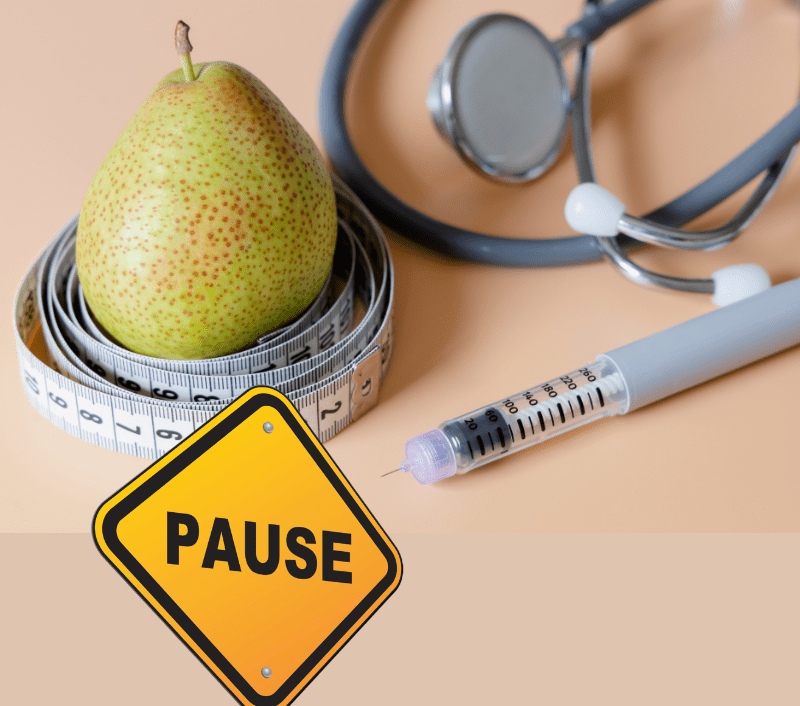
Medications like Ozempic act to mimic the effects of GLP-1 in the body, a hormone naturally produced in the gut that plays a key role in regulating blood sugar and appetite. These medications have been remarkably effective at weight loss, however they do have some downsides. I attended a recent panel discussion where doctors were discussing their concerns and the potential possibilities:
- Negatives: 1) They are expensive and rarely covered by insurance. 2) Patients regain the weight when they discontinue the medication. 3) Rapid weight loss means significant muscle loss – which is hard to rebuild and one of the dangerous reasons we lose functionality in aging.
- Potential possibilities: Because patients regain the weight when they discontinue the medications (and very few people can maintain these medications forever), the doctors did not list weight loss as a a potential benefit. Instead, they pointed to the exciting possibility of behavior change in patients after experiencing lower levels of hunger. The doctors discussed how developing new habits could lead to long-term success. The most important new habit was teaching patients to pause before eating and assess if they are hungry or eating for other reasons.
If you are on Ozempic (or not!) and want to minimize muscle loss – emphasize protein and strength training. When people lose weight, the loss is a combination of fat and muscle. Higher protein diets show similar overall weight loss, but better muscle maintenance and fat loss. After four months of a diet comparison study, subjects on a higher protein diet lost 22% more fat compared to subjects on the lower level. The higher protein group also had more subjects complete the study, suggesting that they were more satisfied.
The standard calculation for protein needs is 0.8 grams of protein per kilogram body weight (0.8 g/kg). However, this amount was determined by balance studies as the minimum level needed before the body begins to break itself down. Studies suggest that 1.5-2 times this amount may be more beneficial, particularly as we age. In a comparison study, older subjects required twenty grams of whey protein (providing two grams of the amino acid leucine) to stimulate muscle protein synthesis. This was twice the amount needed compared to younger subjects.
Challenging, progressive strength-training can build muscle and strength at any age. One study asked older sedentary women (aged 50-70) to do a strength training program of five exercises twice weekly for a year. Results showed bone mineral content was preserved, along with muscle mass and balance, reflecting bodies of 15-20 years more youthful.
Regardless of your feelings about Ozempic, we could all start working on the “pause”. Instead of reaching for a snack when your desire for food strikes, pause for a moment and ask yourself why? What was the trigger? Are you hungry? Are you feeling ungrounded or uncomfortable? Are you eating because you’re bored? And if it’s not hunger, is there another action that could satisfy what you are craving?
- Ungrounded – Eating when we feel ungrounded is tied to our body and mind’s quest for stability and comfort. Food, especially the comforting kind—think carbs, sweets, or creamy textures—has a grounding effect. Eating triggers the release of feel-good chemicals like dopamine and serotonin. These neurotransmitters help calm the nervous system, giving you a sense of security, even if it’s temporary. It’s like giving your mind a warm hug when everything else feels out of control.
- Bored – Eating from boredom comes from a lack of stimulation. When there’s nothing engaging your mind or body, eating fills the void. It gives you something to do, a sense of purpose or pleasure when the moment feels flat. The act of eating becomes a way to fill time or create a spark of interest, even if you’re not physically hungry.
- Uncomfortable Feelings – Food can act as an escape from uncomfortable feelings, like sadness, anger, or anxiety. In this situation, eating is used for a numbing effect allowing us to push the emotions aside temporarily and distract us. The food becomes a buffer from emotions that might feel too big or overwhelming to handle.
- Craving comfort – Think back to childhood: food often meant connection, safety, and care. Sometimes we eat because we are seeking to recreate that sense of being nurtured. It’s not about the food itself, it’s about what the act of eating represents.
All these behaviors stem from a desire to feel better. While food offers a quick fix, it’s not a long-term solution. The root of feeling ungrounded, overwhelmed, bored or wanting comfort goes deeper. Maybe you need to pause and take a few deep breaths, move your body, or connect with someone who truly sees you. Or maybe it’s about addressing the stressors in your life head-on. If you want more on this, as well as a chart of alternative suggestions you can download my food strategies guide for free here: https://www.vibrantjuicylife.com/CopingSignup
The next time you find yourself reaching for snacks in a moment of unease, ask yourself: What am I really hungry for? Maybe it’s comfort, connection, or clarity. By tuning in to what your body and heart need, you can find new ways to nurture yourself that go beyond food. You don’t even have to change your behavior, but by developing the habit of asking you enable yourself to make conscious choices.
If you would like to go deeper, you can book a consultation with me or enroll in the next cohort of my 12-week Transformation starting January 20th!
References
- Suran M. As Ozempic’s Popularity Soars, Here’s What to Know About Semaglutide and Weight Loss. JAMA. 2023 May 16;329(19):1627-1629. doi: 10.1001/jama.2023.2438.
- Nelson ME, Fiatarone MA, Morganti CM, et al. Effects of High-Intensity Strength Training on Multiple Risk Factors for Osteoporotic Fractures: A Randomized Controlled Trial. JAMA. 1994;272(24):1909–1914. doi:10.1001/jama.1994.03520240037038.
- Lancha AH, Zanella R, Tanabe S, et al. Dietary protein supplementation in the elderly for limiting muscle mass loss. Amino Acids 49, 33–47 (2017). doi: 10.1007/s00726-016-2355-4.
- Katsanos CS, Kobayashi H, Sheffield-Moore M, Aarsland A, Wolfe RR. A high proportion of leucine is required for optimal stimulation of the rate of muscle protein synthesis by essential amino acids in the elderly. Am J Physiol Endocrinol Metab. 2006 Aug;291(2):E381-7. doi: https://doi.org/10.1152/ajpendo.00488.2005.
- Soenen S, Martens EA, Hochstenbach-Waelen A, et al. Normal protein intake is required for body weight loss and weight maintenance, and elevated protein intake for additional preservation of resting energy expenditure and fat free mass. J Nutr. 2013 May;143(5):591-6. doi: 10.3945/jn.112.167593.
- Layman DK, Evans EM, Erickson D, et al. A moderate-protein diet produces sustained weight loss and long-term changes in body composition and blood lipids in obese adults. J Nutr. 2009 Mar;139(3):514-21. doi: 10.3945/jn.108.099440.
- Weijs PJM, Wolfe RR. Exploration of the protein requirement during weight loss in obese older adults. Clin Nutr. 2016 Apr;35(2):394-398. doi: 10.1016/j.clnu.2015.02.016.
 Vibrant Juicy Life Blog