
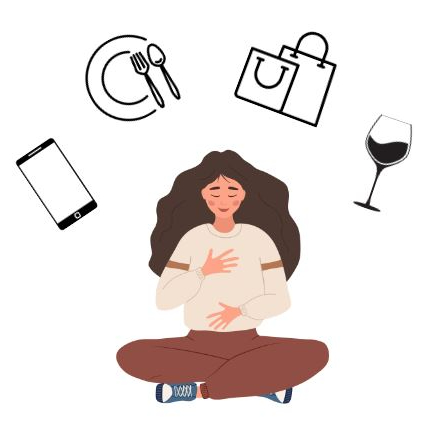
Most people practice some kind of eating restraint. Generally, this is easily guided by hunger. When you feel full, you stop eating! For people who have struggled with weight most of their lives, this mechanism is out of service. It is harder to feel “full”, if not impossible. People are told to eat fewer calories by choosing low-calories foods and limiting portions. I hope this works for you, but it did not work for me. No matter how much I ate, I never felt full. This is because I am eating to fill an emptiness inside me that has nothing to do with food.
Of course this means lifelong struggles with weight. I tried every diet out there including weight watchers, South Beach, Zone, Atkins, paleo, keto. I got a graduate degree in nutrition biochemistry, and became a registered dietitian. None of these things were answers. It’s not knowing more about nutrition or the right combination of macros, I have to face my feelings and learn new ways of being.
I am still working on feeling my feelings. For most of my life, I numbed these feelings with food. I think most of us have some sort of dark place inside we can try to inappropriately fill with shopping, drugs, alcohol, food, porn, etc. I have a food addiction. It has nothing to do with hunger. I can reach for a snack as I am putting down my fork from dinner. Somewhere early in my life I discovered that eating numbs the feelings, and decided to go with that.
In his book “The Seat of the Soul”, Gary Zukav says about addictions “Try to realize, and truly realize, that what stands between you and a different life are matters of responsible choice.” He says that every time our addiction rears up, we get to make a choice between our higher self and our lower self. This means that every time I want to eat for reasons other than hunger, I have the chance to grow stronger and choose my higher self. I proclaim to like growth, so aren’t I lucky to have a chance to grow so many times a day! If it helps, my lower self triumphs fairly often. This doesn’t mean to throw in the towel though. Every new eating occasion is a new chance to choose higher self.
Here are a variety of practices I have found moderately effective:
Journaling.
I journal every single day and start my page with: Today I am feeling….
The more I can learn to distinguish my feelings, the more I can use them to guide me instead of letting them terrify me into numbing them out of existence. My first page is usually just a circular loop of rehashing a particular struggle, but by page 2 I have started to get underneath. Writing helps me gain perspective, helping me to see things from a different angle and see patterns in my emotions and behavior.
Movement.
I have to have significant movement almost every day, aggressive enough that it takes me out of my head and into my body. My body has a simpler take on things that the chaotic mess inside my head. The uncomfortable feelings I try to avoid can be met with grace when I come out of my churning mind and into being present to this moment. It’s when I look backwards and think about what I should have done, or worry about what’s coming that I spiral out of control. The more often you can exercise this muscle, the more it will become habit.
Avoid triggers.
Food triggers are specific foods or food ingredients that can cause physical or emotional reactions in some people. These reactions include a range of symptoms, such as headaches, digestive issues, skin problems, fatigue, anxiety, depression, and can also include emotional responses like mood swings, anxiety or depression. Common food triggers include dairy products, gluten, sugar, caffeine, alcohol, and processed foods.
Through the years I have identified several of my food triggers. In my 20’s I did an elimination diet and removed common food triggers. When I added gluten back I had about 20 minutes of bone-tired exhaustion. For over a decade, I would weigh my decision to eat gluten against the exhaustion and sometimes gluten would win. I have some sort of immune reaction to gluten, but it is not celiac. As the years went by, my symptoms increased to joint pain and irritability. Now that my gluten-induced joint pain lasts over a week, I haven’t found any foods worth it for years.
I have also found that sugar and refined carbohydrates (flour, white rice, bread, pasta, crackers, etc) make me insatiable. These foods are triggers for me, and I just want more… More…. MORE. Sugar and processed foods are inflammatory. Research has found an association between even low levels of inflammation and impulsivity, which may be partly to blame for why they cause me to keep eating. Study subjects with inflammation were less able to delay gratification, making them less able to stick to restrained eating and more prone to poor choices. Inflammation has also been associated with depression, anxiety, and poor working memory. For those of us with emotional eating struggles, these mental challenges make it harder to stay on track.
Similarly, when I tried diets that emphasize low-calorie foods like salads, popcorn, or fruit, I just keep eating. I would obsessively hoard my daily calories until evening so I could have a big dinner and feel satisfied. I am not saying this strategy does not work for some, it just does not work for me. I do better with an eating lifestyle focused on protein and vegetables. Eating this way keeps my emotions manageable and my belly full.
I am sure it sounds dramatic to give up sugar and refined carbohydrates. Maybe you can just eat less? I hope so. Try it, and see how you feel. For me, I had to give them up entirely so that I could be set free. The best way to identify food triggers is to cut everything out for 30 days. Just eating less of your triggers will not tell you which foods are the problems. The good news is that after 30 days, you add the foods back one at a time and see how you feel. It turns out blueberries are not a trigger for me! They are delicious (yes!), AND I don’t keep eating them until I feel miserable. You will want to keep a food diary to identify which foods cause specific reactions. This can help you begin to identify patterns and make connections between your diet and your symptoms. You will likely find you can bring back some foods without any issues.
Mindfulness.
Focusing on the enjoyment of your meal. This is an eating occasion, and I love food! Thich Nhat Hanh suggests focusing on how the food came to be in his book “How to Eat”. Contemplate the fields where the food was grown, the farmer, the process the ingredients took to become food: “Bread comes from the wheat fields, from hard work, and from the baker, the supplier, and the seller. But the bread is more than that. The wheat field needs clouds and sunshine. So in this slice of bread there is sunshine, there is cloud, there is the labor of the farmer, the joy of having flour, and the skill of the baker and then – miraculously! – there is the bread. The whole cosmos has come together so that this piece of bread can be in your hand.”
Mindful eating is a practice of being present and fully engaged while eating food. To practice mindful eating, start by creating a peaceful and distraction-free environment. Turn off the television, put away your phone, and focus on the food in front of you. Take a few deep breaths and become aware of your body and its sensations. Pay attention to the colors, smells, and textures of the food on your plate. Tune into the body’s hunger and fullness signals. Why are you eating? Are you hungry, bored, stressed?
As you eat take small bites, chew slowly, and pause frequently to check-in. Pay attention to the sensations in your mouth and how they change as you chew. How does the food feel in your mouth? Savor the experience in your mouth, the flavor and texture. Does it tastes like you thought it would taste? By tuning in, you can make more informed decisions about what and how much to eat. Notice when you start to feel full and pause to assess your hunger level. If you’re still hungry, continue eating, but if you’re satisfied, stop and save the rest for later.
References
- Freeman CR, et al. Impact of sugar on the body, brain, and behavior. Front Biosci (Landmark Ed). 2018 Jun 1;23(12):2255-2266.
- Beecher K, et al. Sucrose Consumption Alters Serotonin/Glutamate Co-localisation Within the Prefrontal Cortex and Hippocampus of Mice. Front Mol Neurosci, June 2021. 14:678267.
- Yang Y, et al. The association between obesity and lower working memory is mediated by inflammation: Findings from a nationally representative dataset of U.S. adults. Brain Behav Immun. 2020 Feb;84:173-179.
- Gassen J, et al. Inflammation Predicts Decision-Making Characterized by Impulsivity, Present Focus, and an Inability to Delay Gratification. Sci Rep. 2019; 9: 4928.
- Hollands GJ, Shemilt I, Marteau TM, et al. Portion, package or tableware size for changing selection and consumption of food, alcohol and tobacco. Cochrane Database Syst Rev. 2015 Sep 14;2015(9):CD011045.
- Warren JM, Smith N, Ashwell M. A structured literature review on the role of mindfulness, mindful eating and intuitive eating in changing eating behaviours: effectiveness and associated potential mechanisms. Nutr Res Rev. 2017 Dec;30(2):272-83.
- Thich Nhat Hanh. How to Eat. Mindfulness Essentials, Vol 2. Parallax Press, 2014
- Zukav, G. The Seat of the Soul. United States: Simon & Schuster, 2014
 Vibrant Juicy Life Blog